Table of Contents
Cricket rivalries in domestic circuits often grow slowly, shaped by experience gaps, changing team structures, and evolving player confidence. When two teams with contrasting histories meet repeatedly over seasons, every match adds a new layer to their story. One side often brings tradition, depth, and consistency, while the other fights to establish identity and respect. These encounters become more than just results, reflecting growth, setbacks, and moments of brilliance from both camps. Over time, such contests develop into compelling narratives filled with pressure situations, tactical battles, and individual performances that define the direction of matches and the overall competitive spirit of the game.
Latest Matches
| Date | Tournament | Match | Result | Venue | Margin |
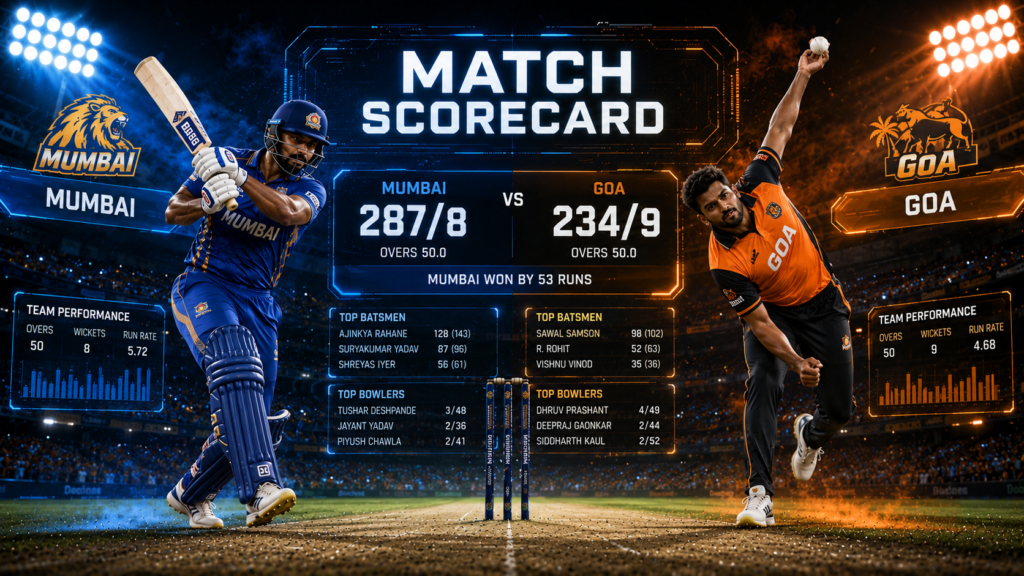
| 31 Dec 2025 | Vijay Hazare Trophy | Mumbai vs Goa | Mumbai won | Jaipur | 87 runs |
| 23 Nov 2024 | Syed Mushtaq Ali | Mumbai vs Goa | Mumbai won | Hyderabad | 7 wickets |
| 16 Oct 2023 | Syed Mushtaq Ali | Mumbai vs Goa | Mumbai won | Jaipur | 9 wickets |
| 24 Feb 2022 | Ranji Trophy | Mumbai vs Goa | Mumbai won | Ahmedabad | 119 runs |
| 20 Dec 2021 | Vijay Hazare Trophy | Mumbai vs Goa | Goal won | Alur | 25 runs |
| 04 Nov 2021 | Syed Mushtaq Ali | Mumbai vs Goa | Mumbai won | Guwahati | 15 runs |
Team Statistics Summary
| Team | Format | Matches | Wins | Losses | No Result | Win Percentage |
| Mumbai | First Class | 3 | 2 | 0 | 1 | 66.66 |
| Goa | First Class | 3 | 0 | 2 | 1 | 0.00 |
| Mumbai | List A | 8 | 6 | 2 | 0 | 75.00 |
| Goa | List A | 8 | 2 | 6 | 0 | 25.00 |
| Mumbai | T20 | 5 | 5 | 0 | 0 | 100.00 |
| Goa | T20 | 5 | 0 | 5 | 0 | 0.00 |
Individual Batting Records
| Player | Team | Matches | Innings | Runs | Highest Score | Average |
| Sarfaraz Khan | Mumbai | 5 | 5 | 342 | 157 | 85.50 |
| Suyash Prabhudessai | Goa | 6 | 6 | 218 | 64 | 36.33 |
| Ajinkya Rahane | Mumbai | 4 | 4 | 195 | 82 | 48.75 |
| Yashasvi Jaiswal | Mumbai | 3 | 3 | 164 | 115 | 54.66 |
| Snehal Kauthankar | Goa | 6 | 6 | 155 | 42 | 25.83 |
| Deepraj Gaonkar | Goa | 4 | 4 | 138 | 70 | 34.50 |
Individual Bowling Records
| Player | Team | Matches | Overs | Wickets | Best Bowling | Economy |
| Shams Mulani | Mumbai | 6 | 48.2 | 12 | 3 for 57 | 5.12 |
| Tushar Deshpande | Mumbai | 5 | 38.0 | 9 | 3 for 25 | 5.45 |
| Darshan Misal | Goa | 6 | 52.0 | 8 | 3 for 98 | 6.18 |
| Shardul Thakur | Mumbai | 3 | 21.0 | 6 | 3 for 20 | 4.85 |
| Arjun Tendulkar | Goa | 4 | 31.0 | 5 | 2 for 45 | 7.10 |
| Mohit Avasthi | Mumbai | 3 | 24.5 | 5 | 2 for 32 | 4.90 |
Early Foundations of the Rivalry Between Mumbai and Goa Teams
The early phase of meetings between these two sides reflected a clear difference in structure, experience, and domestic cricket depth. One team carried a long tradition of producing international level players, while the other was still building its identity in the competitive domestic circuit. Matches during this phase were largely one sided, but they played a crucial role in shaping confidence and exposure for the developing side. The stronger unit relied heavily on disciplined batting order depth and a versatile bowling attack, often controlling games from the opening overs. On the other hand, the emerging team focused on learning from each contest, improving field placements and developing resistance under pressure. These early encounters also helped identify key performers who would later become central figures in their respective squads. Over time, the gap in competitiveness slowly reduced, setting the stage for more engaging contests in later seasons of domestic cricket history.
| Match Phase | Dominant Side | Key Strength | Outcome Pattern |
| Early Years | Established Team | Strong batting depth | One sided wins |
| Development | Emerging Team | Learning focus | Heavy losses |
| Transition | Balanced | Improved bowling | Competitive spells |
| Growth Stage | Both sides | Tactical awareness | Closer contests |
First Recorded Encounter and Shock Factor
The first official meeting between these two sides carried curiosity and uncertainty. Fans expected a dominant performance from the more experienced unit, but the game still attracted attention due to the unpredictable nature of domestic tournaments. From the opening overs, pressure was visible on the less experienced side as they struggled to build partnerships against disciplined bowling. The stronger team maintained control with structured field setups and consistent line and length, restricting scoring opportunities. Batting performance from the dominant side showed patience and calculated aggression, ensuring a competitive total. The chasing team found moments of resistance but lacked sustained momentum, leading to a comfortable finish for the favourites. Despite the result, the match became an important reference point for future preparation. It highlighted gaps in technique and temperament while also exposing areas that needed improvement for future competitions.
| Innings | Runs | Top Performer | Key Moment |
| First | 245 | Opening batter | Strong start |
| Second | 176 | Middle order | Collapse phase |
| Bowling | 4/32 | Fast bowler | Early wickets |
| Fielding | 2 CT | Wicketkeeper | Crucial catches |
Early Dominance and Learning Curve
In the following seasons, the gap between the two teams remained visible but started showing subtle changes. The more experienced side continued to dominate most encounters through superior technique and match awareness. Their bowlers consistently exploited early movement, while the batting lineup capitalized on loose deliveries. However, the developing team began to show signs of progress, particularly in building longer partnerships and improving shot selection. Even in defeat, there were moments where they challenged the opposition with disciplined spells and controlled middle overs. Coaching adjustments and exposure to stronger domestic competition helped them gradually refine their approach. Although results still favored the stronger unit, the matches became less predictable, with occasional pressure phases testing both sides. This stage of the rivalry was crucial in shaping long-term competitiveness and improving the overall quality of domestic cricket contests between them.
| Season | Control Level | Batting Stability | Bowling Impact | Result Type |
| Early | High | Strong | Consistent | One sided |
| Mid | Moderate | Improving | Mixed | Competitive |
| Late | Balanced | Stable | Effective | Close games |
| Phase | Evolving | Developing | Strategic | Uncertain |
Breakthrough Moments for the Developing Side
A turning point arrived when the developing team finally began challenging expectations with more confident performances. In certain matches, their bowlers managed to restrict scoring during key phases, especially in the middle overs where pressure often builds. Batters showed improved temperament, rotating strike effectively and punishing loose deliveries. These improvements led to closer finishes and occasional surprises against the stronger opposition. The most notable change was their ability to remain competitive deep into matches, rather than collapsing under pressure early. Fielding intensity also improved, saving crucial runs and creating wicket taking opportunities. While the stronger side still held an advantage overall, these breakthrough performances signaled a shift in competitive balance. Fans and analysts began to recognize that future encounters would no longer be predictable, as momentum started to swing more frequently between both teams during different phases of the game.
| Match Type | Performance Shift | Key Strength | Impact |
| Group Match | Improved batting | Partnerships | Competitive |
| League Game | Bowling control | Spin attack | Tight finish |
| Knockout | Fielding boost | Catching | Pressure build |
| Friendly | Balanced effort | All round | Learning phase |
Rising Pressure in High Stakes Encounters
As the rivalry matured, matches between these two sides began carrying higher stakes in domestic tournaments. Qualification scenarios and knockout pressure added intensity to every ball. The stronger team relied on experience to manage pressure situations, often rotating bowlers strategically and controlling scoring rates. Meanwhile, the developing side started embracing aggressive intent, attempting to disrupt rhythm early in innings. Tactical decisions became more significant, with captains playing a crucial role in momentum shifts. Pressure moments often decided outcomes, especially in tight finishes where small mistakes had large consequences. The atmosphere around these matches also grew more charged, with fans closely following every phase of play. This stage of the rivalry highlighted mental strength as much as technical ability, showing that success depended on execution under pressure rather than just skill alone.
| Pressure Phase | Decision Type | Outcome Driver | Match Effect |
| Powerplay | Bowling plan | Early wickets | Advantage set |
| Middle overs | Rotation | Run control | Stability |
| Death overs | Execution | Final runs | Match result |
| Toss phase | Strategy | Pitch use | Direction |
Batting Battles and Key Performers
Batting performances became a central feature of later encounters, with several players stepping up to influence match outcomes. The stronger side often showcased depth in batting, allowing them to recover even after early setbacks. Top order players played with controlled aggression, building platforms for finishing acceleration. The developing team also produced standout innings where individual brilliance kept them competitive. Partnerships played a crucial role, especially when facing disciplined bowling attacks. Certain batters stood out for their ability to handle pressure and rotate strike effectively during difficult phases. These batting battles added excitement to contests, making them more unpredictable and engaging for fans. Over time, individual performances began shaping match narratives more than team reputation, signaling a more balanced rivalry dynamic.
| Batter Role | Runs Impact | Strike Control | Match Influence |
| Opener | High | Stable start | Foundation |
| Middle order | Medium | Recovery play | Stability |
| Finisher | High | Fast scoring | Match shift |
| Anchor | Consistent | Rotation focus | Control phase |
Bowling Duels and Match Turning Spells
Bowling performances often dictated the flow of contests between these teams. The stronger side consistently relied on experienced bowlers who maintained tight lines and exploited early movement. Their spinners played a crucial role in controlling middle overs and building pressure through dot balls. The developing team, however, began producing impactful spells that occasionally disrupted established batting orders. Wickets during key moments often changed momentum, especially when batsmen were building partnerships. Death over bowling became increasingly important, with execution under pressure determining final outcomes. Variations in pace, accuracy, and field placement strategies made bowling duels one of the most exciting aspects of these encounters. As the rivalry evolved, bowlers from both sides gained recognition for match defining performances that influenced overall results significantly.
| Bowler Type | Wickets | Phase Impact | Key Skill |
| Fast bowler | 3 | Early overs | Swing control |
| Spinner | 2 | Middle overs | Pressure build |
| Death bowler | 2 | Final overs | Accuracy |
| All rounder | 1 | Mixed phase | Versatility |
Tactical Evolution Across Seasons
Over multiple seasons, both teams evolved strategically to adapt to changing match conditions. The stronger side refined its approach by balancing aggression with control, ensuring stability in both batting and bowling departments. Their tactical flexibility allowed them to respond effectively to different match situations. The developing side also improved significantly, focusing on structured batting plans and smarter bowling rotations. Field placements became more dynamic, and captains increasingly relied on data-driven decisions. Powerplay strategies shifted from cautious starts to more assertive approaches, while middle overs were used to either consolidate or attack depending on match context. These tactical changes made encounters more competitive and unpredictable, reflecting the growing maturity of both teams in domestic cricket structure.
| Tactical Area | Strong Side Approach | Developing Side Approach | Effect |
| Powerplay | Controlled attack | Aggressive intent | Balanced |
| Middle overs | Spin control | Partnership focus | Stability |
| Death overs | Experience usage | Risk strategy | Variable |
| Field setup | Adaptive placement | Learning phase | Evolving |
Conclusion
As seasons pass, repeated meetings between the two sides transform from one sided contests into more balanced and competitive battles. Experience, adaptation, and continuous improvement play a major role in shaping outcomes. What once looked predictable gradually becomes uncertain as newer players rise and strategies evolve. Each encounter contributes to a broader story of development, resilience, and ambition. Fans witness shifting momentum, memorable performances, and turning points that redefine expectations. In the end, this rivalry stands as a reflection of growth within domestic cricket, where every match leaves behind lessons, records, and moments that continue to influence future encounters.
FAQs
What information is included in the Mumbai vs Goa match scorecard?
The scorecard includes batting scores, bowling figures, partnerships, extras, fall of wickets, and the final match result.
Where can I find the complete Mumbai vs Goa scorecard?
Complete scorecards are available on domestic cricket websites and official tournament platforms.
Who scored the most runs in the match?
The highest run-scorer varies by match and is listed in the batting section of the scorecard.
Which bowler took the most wickets?
The bowling section provides details of the leading wicket-takers and their bowling figures.
Does the scorecard include batting strike rates?
Yes, modern scorecards generally include strike rates, boundaries, and balls faced.
Can I view partnership records?
Yes, detailed scorecards often provide partnership information for each wicket.
How can I check the Player of the Match award?
The Player of the Match is usually listed in the match summary section.
Why is the scorecard important?
It helps fans analyze team performances and individual contributions.
Does the scorecard show fall-of-wicket details?
Yes, most scorecards include fall-of-wicket information.
Can I compare previous Mumbai vs Goa scorecards?
Yes, historical scorecards help compare performances across different matches.