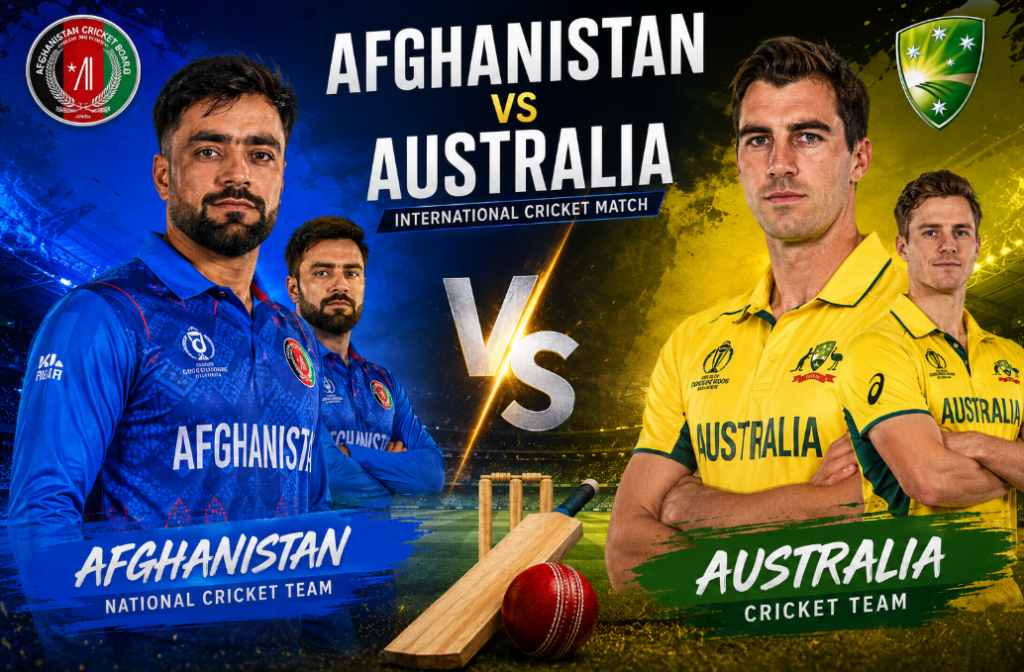
The encounters between Afghanistan and Australia in international cricket represent a growing story of ambition meeting experience. Australia, known for its structured dominance and world class match awareness, has traditionally controlled these contests through discipline and depth. Afghanistan, however, has steadily emerged as a fearless challenger, bringing spin strength, aggressive intent, and a rapidly improving game sense. Every meeting between these two sides reflects a clear evolution, where Afghanistan continues to learn and adapt while Australia works to maintain its supremacy. The rivalry is not just about results but about the journey of a rising team testing itself against one of cricket’s greatest powerhouses on the global stage.
Recent Matches
Date
Format
Venue
Winner
Margin
Score 1
Score 2
28 Feb 2025
ODI
Lahore
No Result
Match Abandoned
AFG 273 All Out
AUS 109/1
22 Jun 2024
T20I
Kingstown
Afghanistan
21 Runs
AFG 148/6
AUS 127 All Out
07 Nov 2023
ODI
Mumbai
Australia
3 Wickets
AFG 291/5
AUS 293/7
04 Nov 2022
T20I
Adelaide
Australia
4 Runs
AUS 168/8
AFG 164/7
01 Jun 2019
ODI
Bristol
Australia
7 Wickets
AFG 207 All Out
AUS 209/3
04 Mar 2015
ODI
Perth
Australia
275 Runs
AUS 417/6
AFG 142 All Out
25 Aug 2012
ODI
Sharjah
Australia
66 Runs
AUS 272/8
AFG 206 All Out
Team Statistics Summary
Team
Matches
Won
Lost
Tied
No Result
Win Percentage
Australia
7
5
1
0
1
71.42
Afghanistan
7
1
5
0
1
14.28
Overall ODI
5
4
0
0
1
80.00
Overall T20I
2
1
1
0
0
50.00
Batting First Won
7
3
4
0
0
42.85
Chasing Won
7
3
4
0
0
42.85
Neutral Venues
5
3
1
0
1
60.00
Individual Batting Records
Player
Team
Matches
Innings
Runs
Highest Score
Average
Glenn Maxwell
Australia
5
5
393
201
98.25
Ibrahim Zadran
Afghanistan
4
4
224
129
74.66
David Warner
Australia
4
4
215
178
53.75
Mitchell Marsh
Australia
4
4
124
45
31.00
Rahmanullah Gurbaz
Afghanistan
3
3
111
60
37.00
Sediqullah Atal
Afghanistan
1
1
85
85
85.00
Marcus Stoinis
Australia
3
3
64
25
21.33
Individual Bowling Records
Player
Team
Matches
Overs
Wickets
Best Bowling
Economy
Adam Zampa
Australia
5
34.0
9
3/28
4.91
Rashid Khan
Afghanistan
5
36.5
8
2/41
5.34
Mitchell Starc
Australia
3
29.0
7
4/18
4.34
Gulbadin Naib
Afghanistan
4
20.0
6
4/20
5.85
Naveen-ul-Haq
Afghanistan
3
21.0
6
3/20
5.57
Pat Cummins
Australia
4
27.0
6
3/28
5.11
Josh Hazlewood
Australia
3
26.0
5
2/39
4.53
Afghanistan vs Australia Rivalry Development
The early phase of this rivalry shows a clear gap in experience and execution, but also highlights how quickly Afghanistan began learning from high-pressure international exposure. Australia entered these contests as a dominant force with a settled core of world class players, while Afghanistan arrived with raw energy and fearless intent. Over time, the contests became more competitive as Afghanistan developed stronger batting discipline and sharper tactical awareness. The matches reflected not just results but a learning curve where every encounter added new layers to their competitive identity. Australia’s ability to control key phases of the game often decided outcomes, but Afghanistan’s growing confidence started to challenge that control in unexpected moments, especially through spin bowling in middle overs.
Match Phase
Australia Approach
Afghanistan Approach
Key Impact
Momentum Shift
Powerplay
Aggressive start
Cautious buildup
Early wickets crucial
Australia dominant
Middle Overs
Rotation control
Spin pressure
Run rate control battle
Balanced phase
Death Overs
Explosive finish
Defensive setup
Final score shaping
Australia stronger
Bowling Plan
Pace heavy attack
Spin focused attack
Tactical contrast
Mixed control
Field Strategy
Tight aggressive field
Deep defensive field
Pressure management
Situational
Early International Clashes Experience Gap
The first meetings between these teams clearly exposed the difference in experience at the highest level. Australia relied on structured batting depth and disciplined bowling, while Afghanistan depended heavily on individual brilliance. Despite the result gap, Afghanistan showed glimpses of potential through their spin attack and moments of resistance in the middle order. These matches were less about rivalry intensity and more about Afghanistan adapting to elite standards. Australia maintained control in most departments, but Afghanistan gained valuable exposure that later shaped their competitive mindset. Each innings provided lessons that would eventually help them close the gap in future encounters.
Aspect
Australia Strength
Afghanistan Limitation
Learning Outcome
Match Effect
Batting Depth
Strong lineup
Inconsistent order
Stability needed
One sided
Bowling Attack
Pace dominance
Spin reliance
Balance required
Controlled
Fielding Level
High precision
Developing unit
Improvement path
Pressure gaps
Experience
Elite exposure
Limited exposure
Growth phase
Predictable results
Match Control
Full dominance
Reactive strategy
Tactical learning
Clear advantage
Afghanistan Growth and Competitive Transformation
As Afghanistan continued playing against top-tier opponents, their transformation became more visible in both batting confidence and bowling execution. The spin unit evolved into a major threat, capable of restricting world class batters during middle overs. Australia, on the other hand, started preparing more specifically for spin-heavy conditions, showing respect for Afghanistan’s emerging strength. This phase marked a shift where Afghanistan was no longer just participating but actively competing in key segments of the game. Although Australia still held the upper hand in most encounters, the margin of dominance began to reduce gradually, signaling a maturing contest between the two sides.
Development Area
Afghanistan Progress
Australia Response
Tactical Change
Impact Level
Spin Bowling
Highly improved
Careful planning
Defensive approach
High
Batting Stability
Gradual improvement
Target pressure zones
Strategic bowling
Medium
Game Awareness
Increasing maturity
Analytical planning
Match-ups focus
High
Death Overs
Still developing
Strong execution
Controlled finish
Very High
Confidence Level
Rising steadily
Consistent mindset
Balanced rivalry
Medium
Breakthrough Competitive Match Phase
A turning point in the rivalry came when Afghanistan managed to challenge Australia more directly in a competitive encounter. This match highlighted Afghanistan’s ability to build partnerships under pressure and sustain resistance against a disciplined bowling attack. Australia still controlled key phases, but Afghanistan’s middle order showed resilience that surprised many observers. The bowling unit also delivered spells that restricted scoring momentum at crucial stages. The scorecard from this phase reflects a much closer contest compared to earlier meetings, indicating a shift in competitive balance and psychological confidence.
Match Element
Afghanistan Performance
Australia Performance
Key Difference
Turning Point
Top Order
Stable start
Early breakthroughs
Control shift
Balanced
Middle Order
Strong resistance
Tactical pressure
Partnership fight
Afghanistan rise
Bowling Spell
Restrictive phases
Wicket efficiency
Even contest
Tight game
Run Rate Control
Moderate stability
Aggressive control
Pressure balance
Swing phase
Final Overs
Survival effort
Finishing strength
Experience gap
Australia edge
Middle Overs Tactical Battle
The middle overs became the most important battlefield in this rivalry, especially due to Afghanistan’s spin strength and Australia’s structured batting approach. Afghanistan often used this phase to build pressure through tight lines and slow down scoring, while Australia focused on rotation and minimizing risk. This phase frequently determined whether Afghanistan could stay competitive or Australia would pull ahead decisively. Over time, both teams refined their strategies, making this segment of play the most closely watched and tactically rich part of their encounters.
Middle Over Factor
Afghanistan Strategy
Australia Strategy
Outcome Influence
Game Control
Spin Usage
Heavy reliance
Careful handling
Run restriction
Balanced
Strike Rotation
Limited but improving
Consistent
Pressure relief
Australia slight
Dot Balls
High pressure creation
Managed risk
Momentum shift
Equal
Wicket Taking
Key weapon
Controlled aggression
Breakthrough impact
Mixed
Tempo Control
Slow buildup
Steady pace
Match shaping
Critical
Conclusion
The Afghanistan versus Australia cricket journey highlights how experience and growth shape modern international cricket rivalries. Australia’s consistency and tactical strength have often given them the upper hand, but Afghanistan’s rise has added a new competitive dimension to these contests. Each match tells a story of learning, pressure handling, and evolving strategies. Afghanistan’s improvement across batting, bowling, and mindset shows their potential to challenge top teams more closely in the future. While Australia remains dominant, the gap is gradually narrowing, making every future encounter more exciting, unpredictable, and significant in the global cricket landscape.